
01NOC Manager
Alert-to-ticket RCA
Event-driven triage on every P3 and P4 that fires overnight. The queue your team currently works through at 08:00 is already diagnosed and ticketed when they arrive.
Read moreAgentic NetOps
Any vendor. Any environment. Always under your control.
It investigates the alert, writes the root-cause analysis, updates the ticket and executes the fix you approve.
Acts, not just alerts
10 related alerts correlated into one incident. No engineer in the path.
Runs where others can't
Fully air-gapped, with local model inference. Nothing leaves your perimeter.
You stay in command
Every command previewed and approved before it runs, audited to your SIEM.
Prefer to watch first? Watch real product demonstrations. For your own infrastructure, discuss a paid pilot.
Alert Received
Intake Alert
Gather Data (Parallel)
Management Plane Check
AI Investigation & RCA
Smart Ticket Handling
Ticket Updated
Acknowledge Alerts
Execution summary
10
Related alerts
1
Incident
No engineer paged
Full audit trail. SIEM ready.
Executes across
Any ITSM with an OpenAPI spec connects in a single sitting.
Supported platforms
NetPrompt AI layers onto your estate rather than replacing it — logging into your devices and reading from the tools your team already runs.
Network devices
ITSM, monitoring and log analytics
Also supported today: Linux, Windows Server, VMware ESXi and Proxmox VE, plus AWS resource operations. Anything else — build a governed connector from an OpenAPI specification in a single sitting.
On the roadmap: Microsoft Azure and Google Cloud resource operations · Jira Service Management · Palo Alto Panorama & Cortex · Prometheus and Grafana.
All product names, logos and brands are the property of their respective owners and are shown to indicate compatibility. Their use does not imply endorsement, affiliation or partnership.
The situation
02:00
An alert fires. Someone is woken. Diagnosis starts from zero — device state here, monitoring there, ticket history somewhere else. By the time the picture is assembled, the incident has been running for an hour.
MIXED
Your incumbent's AI assistant is genuinely good — on your incumbent's equipment. On the other three vendors in your estate it does nothing, so the work falls back to the same small pool of senior engineers who already carry it.
DENIED
Every platform that could help wants your device configurations, addresses and credentials in its cloud. Security has already said no. The capability was never the blocker — the deployment model was.
Acts, not just alerts
Observability tells you something is wrong. ITSM tracks that you know. NetPrompt does something about it — and the whole loop is auditable afterwards.
Alert
The monitoring platform raises a critical alert. No polling delay, no queue, no engineer trigger — the workflow starts the instant the event arrives.
SolarWinds · ServiceNow · Splunk
Investigate
Not a query against a telemetry store — an actual session against the affected equipment, gathering device state, syslog, interface counters and neighbour status in parallel.
Six OEMs · 120+ platform registry
Analyse
Evidence from the devices is correlated against monitoring data, recent changes, ticket history and logs, then reasoned against the original alert to produce a cited analysis and remediation steps.
Cited · reviewable · reproducible
Ticket
If no matching incident exists, the ITSM record is created with the RCA already in it. If one does, the analysis is attached to that incident and the alert related to it rather than opening a duplicate — so the engineer who picks it up starts from a conclusion rather than from a blank incident and a device name.
ServiceNow · opens or relates
Acknowledge
The loop closes. What remains for a human is the decision, not the evidence-gathering that used to consume the first hour of every incident.
Full audit trail to your SIEM
One execution
10 alerts → 1 incident
No engineer paged.
Up to 70% MTTR reduction; typically 40–60% for L1/L2 incident classes.
Vendor-modelled against internal incident data, not independently validated. We will measure it against your own baseline during a pilot.
See NetPrompt in action
The recorded firewall event shows parallel evidence gathering, an explicit diagnostic gap, structured RCA and an existing incident updated—without inventing a fix that did not occur.
You stay in command
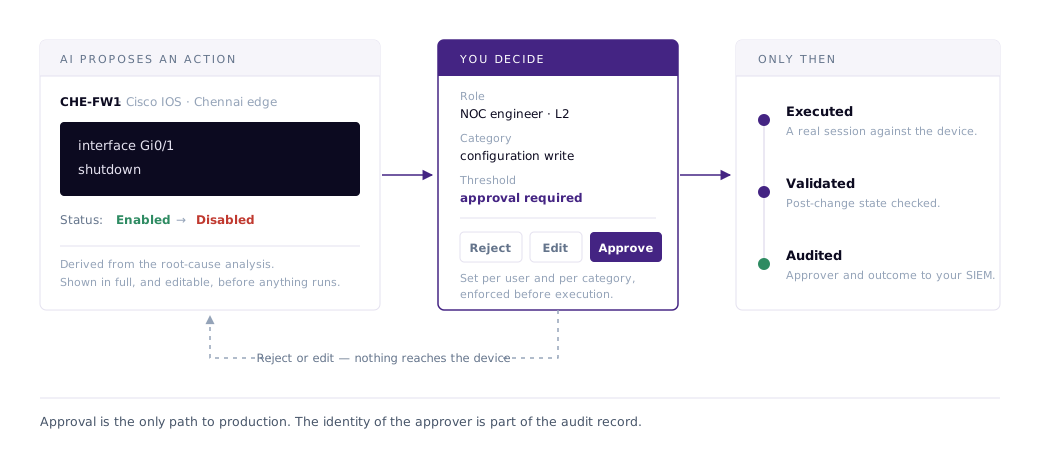
The question every serious evaluator asks is what happens when the AI gets it wrong. It is the right question, and it has a structural answer rather than a reassuring one.
Junior roles are constrained, architects are not, and read-only operations are governed by different rules from configuration writes. Set once, enforced before the model is even scored.
Nothing state-changing runs unreviewed. The generated command is shown before execution and can be edited in place — so the engineer stays the author of what touches production.
Every action, approval and rejection is logged and shipped to the customer’s own SIEM. The audit trail lives in your estate, not in a vendor console you have to request access to.
The control architecture does not depend on the AI being correct. That is the point of it. Where you want measurement, we will instrument command-accuracy tracking during the pilot as an agreed success criterion.
Runs where others can’t
Sensitive values — addresses, credentials, hostnames, SIDs — are tokenised before any model call, cloud or local, and restored only in the final response. The pattern manager that does it is administrator-configurable, so you decide what counts as sensitive.
Cloud scope, precisely
Model inference via Google Cloud, AWS and Azure; available on the AWS and Google Cloud marketplaces; conversational cloud resource operations for AWS.
Model provider is a separate choice from location — local Native AI, a cloud provider, or a switchable mix, on-premises or in your cloud tenancy. Full breakdown on the deployment page.
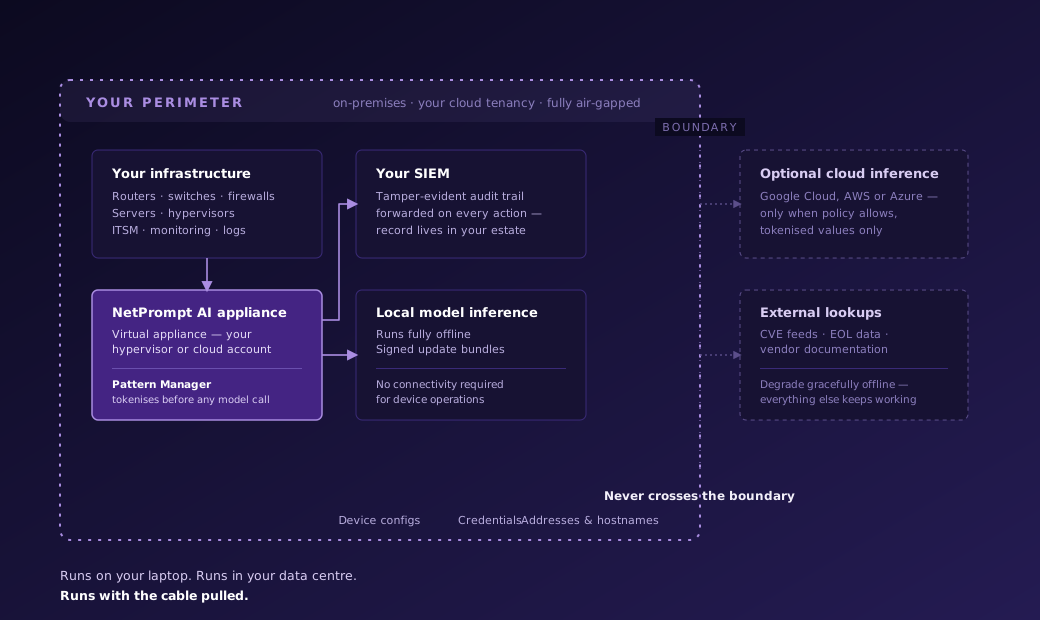
Stated plainly: in a fully air-gapped deployment, external lookups — CVE feeds, end-of-life data and vendor documentation — degrade gracefully, because nothing reaches out. Everything that runs against your own estate continues to work.
Any vendor
Platform-native copilots work properly on their own vendor's hardware. That covers part of your estate. NetPrompt executes across the rest of it under the same interface and the same governance model.
Network devices
Driven by a registry of 120+ platforms — new vendors onboard without a code change.
Servers & hypervisors
NetOps and SysOps under one governance and audit model, with a locked-down read-only mode for production hosts.
Your existing tooling
Anything else — build a governed connector from an OpenAPI specification in a single sitting.
Stated openly: device-level execution is genuinely multi-vendor. Deep controller integration for SD-WAN and wireless is Cisco today (vManage and the 9800 WLC), with vManage also reachable through the OpenAPI connector library. If your controllers are non-Cisco, we will scope those out of a pilot rather than promise parity.
Where it earns its licence
Not a feature list — four routines that currently occupy rostered hours, and what happens to them.
Event-driven triage on every P3 and P4 that fires overnight. The queue your team currently works through at 08:00 is already diagnosed and ticketed when they arrive.
Read moreThe scheduled sweep across sites and device classes that consumes the first hour of the early shift, run on a schedule and reported as an exception list rather than a full readout.
Read moreA written handover assembled from what actually happened — incidents, changes, outstanding tickets and their state — rather than from what the outgoing engineer remembered to write down.
Read moreContinuous threshold and trend monitoring against the commitments you are measured on, with the investigation already done by the time the number becomes a conversation.
Read moreThe common thread is that none of these require a human to start them, and all of them currently do. That is the difference between an assistant you open and an engineer who is already working.
IMC 2026 · Exhibition award
NetPrompt AI is listed as the winner by India Mobile Congress.
Read the award announcement →Gartner · Research mention
Coolest Vendor Innovations in Agentic AI for Enterprise Networking, 14 July 2026.
View the report reference →Early adopters and partners
Managed service providers, hosting and data-centre operators, and enterprise infrastructure teams running NetPrompt AI in evaluation and early production.














Where we are, honestly
Our ecosystem today includes customers, partners, and organizations evaluating NetPrompt AI through pilots and early-production engagements. We do not publish performance numbers unless they have been measured and validated. Before a pilot begins, we agree on success criteria in writing, establish a baseline, and measure outcomes against it. Where the results are meaningful, we ask the organization whether we can publish the findings as a case study.
Founding-customer terms are available for qualifying organizations willing to participate in a quantified case study and reference calls.
Deployment and AI ecosystem
Transact through a cloud marketplace against committed spend, or run entirely inside your own perimeter.
Purchasing through a marketplace draws down committed cloud spend, which routinely removes months from enterprise procurement and bypasses new-vendor onboarding entirely. Model inference runs on Google Cloud, AWS or Azure — or fully locally, on premises or air-gapped, with no data leaving your network.
Technology partners
Development and infrastructure relationships — not additional purchase channels. Every sale outside the two marketplaces above is direct.
NVIDIA Inception Program member · not a purchase channel
Next step
Begin with a short technical walkthrough. If the fit is clear, proceed to a 30-day paid pilot with success criteria agreed before day one.
Already planning a paid evaluation? Here is how the pilot works: